Chinese Robots Revolutionizing UK Retail Sector
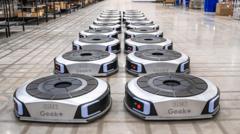
Chinese Robotics Solutions Reshape Britain's Retail Landscape
The United Kingdom's retail sector is experiencing a significant transformation driven by Chinese robots and automation technology. As British retailers grapple with persistent productivity challenges and acute labour shortages, Chinese robotics firms are positioning themselves at the forefront of the industry's digital revolution. This shift represents a critical juncture for UK retail, where automated solutions are increasingly viewed as essential to maintaining competitive advantage in an evolving marketplace.
China's robotics manufacturers have identified substantial opportunities within Britain's retail environment. The combination of weak productivity growth metrics and difficulty recruiting qualified personnel has created a receptive market for advanced automation solutions. These technological interventions promise to streamline operations, reduce dependency on human workforce availability, and enhance overall operational efficiency across warehouses, distribution centres, and retail establishments throughout the nation.
Understanding the Productivity Challenge in British Retail
The UK retail industry has faced consistent headwinds regarding productivity growth. Despite technological advances available globally, many British retailers have been slower to adopt comprehensive automation strategies compared to international competitors. This reluctance, coupled with demographic shifts and changing employment patterns, has left significant operational gaps that Chinese robotic solutions now address directly.
Labour shortages represent an unprecedented challenge for British retail operations. Post-pandemic hiring difficulties, combined with evolving workforce expectations and wage pressures, have forced retail management to reconsider their operational models fundamentally. Many businesses now view Chinese robots and automated systems as pragmatic solutions to these persistent human resources challenges.
How Chinese Robotics Technology is Deployed
Chinese robotics companies are implementing various automation solutions tailored specifically for retail operations. Warehouse robots handle inventory management, sorting, and retrieval tasks with remarkable precision and speed. Automated systems now manage stock rotation, reducing human error while accelerating order fulfillment processes.
These technological implementations extend beyond traditional warehouse environments. Retail establishments are increasingly deploying robotic systems for customer service applications, inventory audits, and facility maintenance. The scalability and relative affordability of Chinese robotic solutions make them particularly attractive to mid-sized and smaller retailers seeking modernization without excessive capital expenditure.
Economic Impact and Industry Transformation
The adoption of Chinese robots in UK retail is generating measurable economic consequences. Retailers implementing these systems report significant operational improvements, including faster processing times, enhanced accuracy in inventory management, and reduced operational costs. These efficiency gains translate directly into competitive advantages within an intensely competitive retail environment.
However, the transformation also raises important considerations regarding employment patterns. While Chinese robots and automated systems address immediate labour shortages, they simultaneously reshape job requirements and employment structures. The retail sector faces a necessary transition toward roles emphasizing technical expertise, system maintenance, and customer relationship management rather than routine operational tasks.
Competitive Advantage Through Automation
British retailers adopting Chinese robotic solutions gain significant competitive positioning. These technological implementations enable businesses to maintain operational continuity despite labour market constraints. Automation enhances consistency in service delivery while simultaneously reducing the operational disruptions that frequently result from staff shortages.
The investment in Chinese robots represents a strategic response to market realities. Rather than continue struggling with recruitment and retention challenges, forward-thinking retailers embrace automation as a fundamental business transformation tool. This approach aligns with broader global trends toward technological integration in retail environments.
Future Implications for UK Retail Industry
As Chinese robotics technology becomes increasingly prevalent within British retail, industry observers anticipate continued acceleration of this transformation. Competition between retailers will likely encourage wider adoption of automated solutions, creating industry-wide standardization around robotic warehouse and retail operations.
The integration of Chinese robots into UK retail operations signals a broader shift toward technology-dependent business models. This evolution requires retailers to develop new workforce competencies, invest in technical infrastructure, and fundamentally reconsider operational philosophies. Successfully navigating this transition will determine competitive success for retailers across Britain's diverse market segments.